
Le Phare Collectif, a female-led collective fostering a safe space for creation
Writing is a deeply personal and vulnerable exercise, one that Natalia Armenia, head of Le Phare Collectif’s writing workshops, believes lives inside each of us, waiting for just a nudge to flourish. But in Paris, home to people from all around the world, finding a comfortable and inclusive space to create can be a challenge, especially if you wish to write in a language other than French. Le Phare bridges this gap by running workshops in French, Spanish, and English, allowing more people to learn and grow in their writing.
Natalia co-founded Le Phare Collectif, a Paris-based non-profit writing collective run by six women from across the world (France, UK, Peru, Ireland, Bolivia and Argentina). Since 2022, they've been hosting trilingual workshops, retreats, a book club, and live readings.
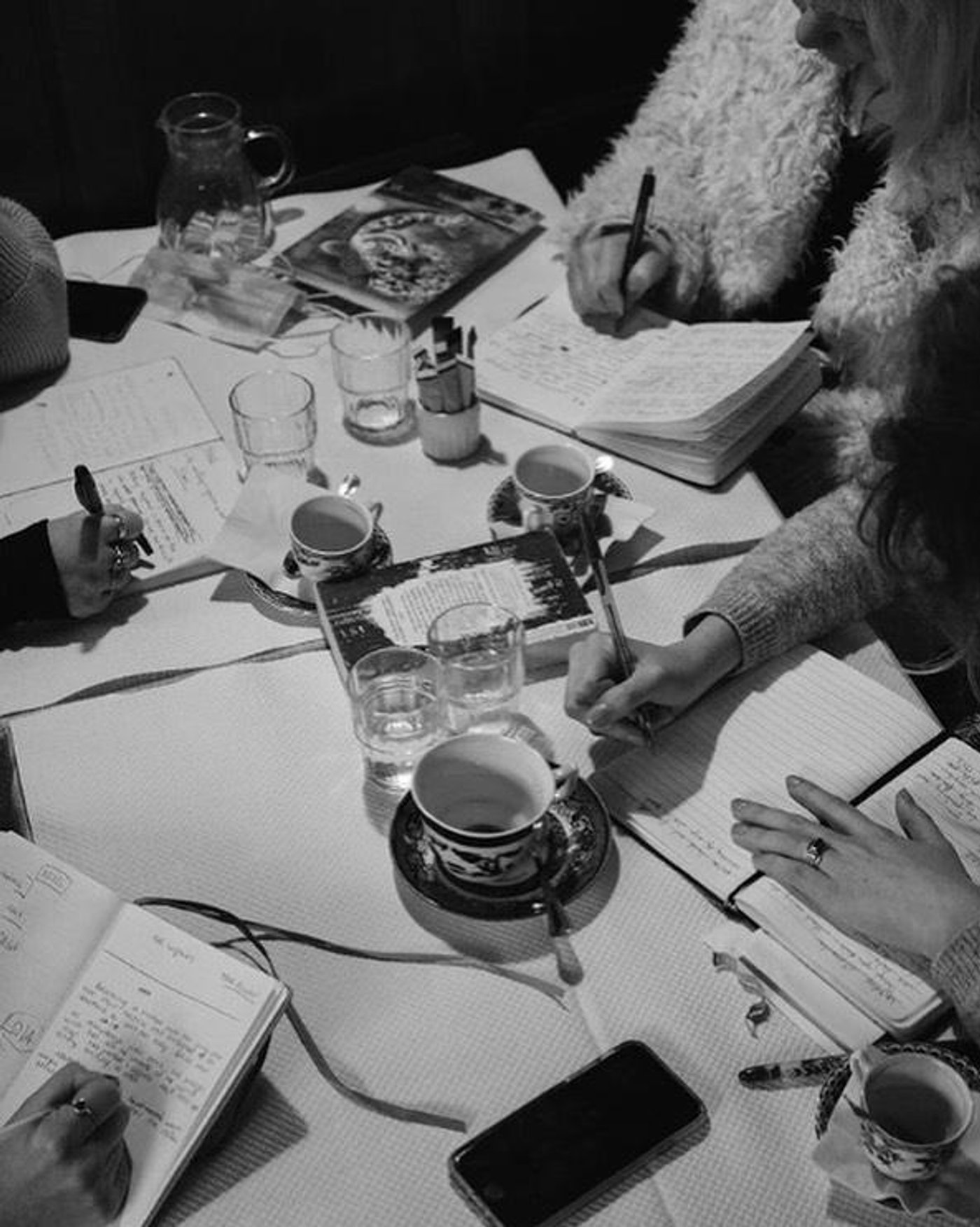
The name "Le Phare", or the lighthouse, was the result of a collective brainstorming. "We wanted a name that was short, that could mean something," Natalia explains. "For us it's the idea that there is a light we can follow. Something that guides you, a momentum. A cheesy all-in-this-together type of thing."
With a Master’s degree in Literature Natalia went on to teach English & Creative Writing at Sorbonne Nouvelle. Most importantly, she has the rare ability to make people who don't think of themselves as writers want to pick up a pen.
Natalia was already organising writing sessions before the association existed, and friends of friends, strangers, found their way there one by one. That loose, organic beginning has since grown into something more structured: five workshops a week, a book club, a screenwriting group, a longer-form writing cohort, events that draw up to 200 people, and an annual book now in its fourth edition. The forthcoming theme is Futurs (previous editions explored Connexions, Détours and Extase).
It’s inspiring to witness Le Phare’s commitment to gather the work of their contributors into something tangible and socially enjoyable. The annual book includes photography solicited through open calls on Instagram, so anyone, anywhere, can submit. Their book launches also double as exhibitions. They book DJs and musicians. Once a year, they print their members' texts and display them in a bar or café for a week, so that the writing can exist in public space, handled, seen, read over a drink. "We like the idea of taking writing to the next level," Natalia says. "It can be performed, said out loud, even touched."
The writing workshops (@lesmotsduphare) are weekly and genre-rotating. Horror fiction one week, poetry the next, novel-writing the one after. This ensures there is something to discover each week and avoids the fatigue that can come with focusing on a subject some might not fully connect with. Each session ends with homework, so that anyone particularly inspired by the topic can keep going on their own. Enrolment is now semester-based, a change that came about once this became Natalia's primary income. "I need people to be committed," she says, "but it works for them too. They know that everyone else respects the fact that they have two hours every week to write."
The collective is explicitly feminist and members sign a form committing to zero tolerance for discrimination before they can join. Some workshops are reserved only for women and non-binary people. "Having non-cis male spaces allows us to claim spaces that can only be ours," Natalia says. When they hold events, they open with a speech about their values. "We will always do that."
The question of money, as with every collective operating outside institutional support, is a complicated one. For paid events and the writing workshops, Le Phare uses a sliding-scale model: members pay according to their income, and those who genuinely cannot pay don't have to. "One person will perhaps be able to afford double the amount of the next one". It's a model that reflects the association's core belief: that writing and access to the creative community should not be determined by class. For now, what they have built is held together by five workshops a week and the loyalty of a community that spans ages 18 to 65.
There is a growing roster of people who have been coming for years, and an equally steady stream of newcomers who show up convinced they are too shy to read aloud and then, almost without exception, do it on their very first session.
Natalia talks about her relationship to writing and how it has evolved with her involvement in the collective. She recognises that sometimes writing is the last thing she wants to do, especially now it’s also her job, but it means detaching yourself from that pressure. “You have to see it as: I really like this, and I'm so happy I can do it.” It's a distinction that feels important in a landscape where creative practice is increasingly asked to justify itself economically. Creative collectives have always been laboratories for community as much as craft, and what Le Phare Collectif has built is no different. In the end, it reminds us that writing doesn't have to earn its place. It can simply belong to you as a tool of exploration, expression and connection.
You can find out more about Le Phare Collectif and Les Mots du Phare on Instagram:
Photo : Le Phare Collectif
Get RÜTM in your inbox

Maria de Faykod, une vie gravée dans le marbre
Après avoir laissé une empreinte indélébile dans les galeries parisiennes et avoir bâti une riche carrière, Maria de Faykod, qui consacre sa vie au marbre, a choisi de plonger avec ses œuvres au cœur de la nature.

Street art à Cherbourg. Une ville à suivre de près
Cherbourg fait partie de ces villes où le street art fait son bout de chemin depuis quelques années. Exploration d’une cité portuaire où la liberté d’expression semble plutôt bien accueillie.
