
Board Boredom
Have you noticed that pretty much every major city pavement has become riddled with some form of stainless steel or mirrored A-frame / sandwich board? While I have heard that it's like this in Paris, Amsterdam, and New York, I'm sure other cities have seen these pop up too.
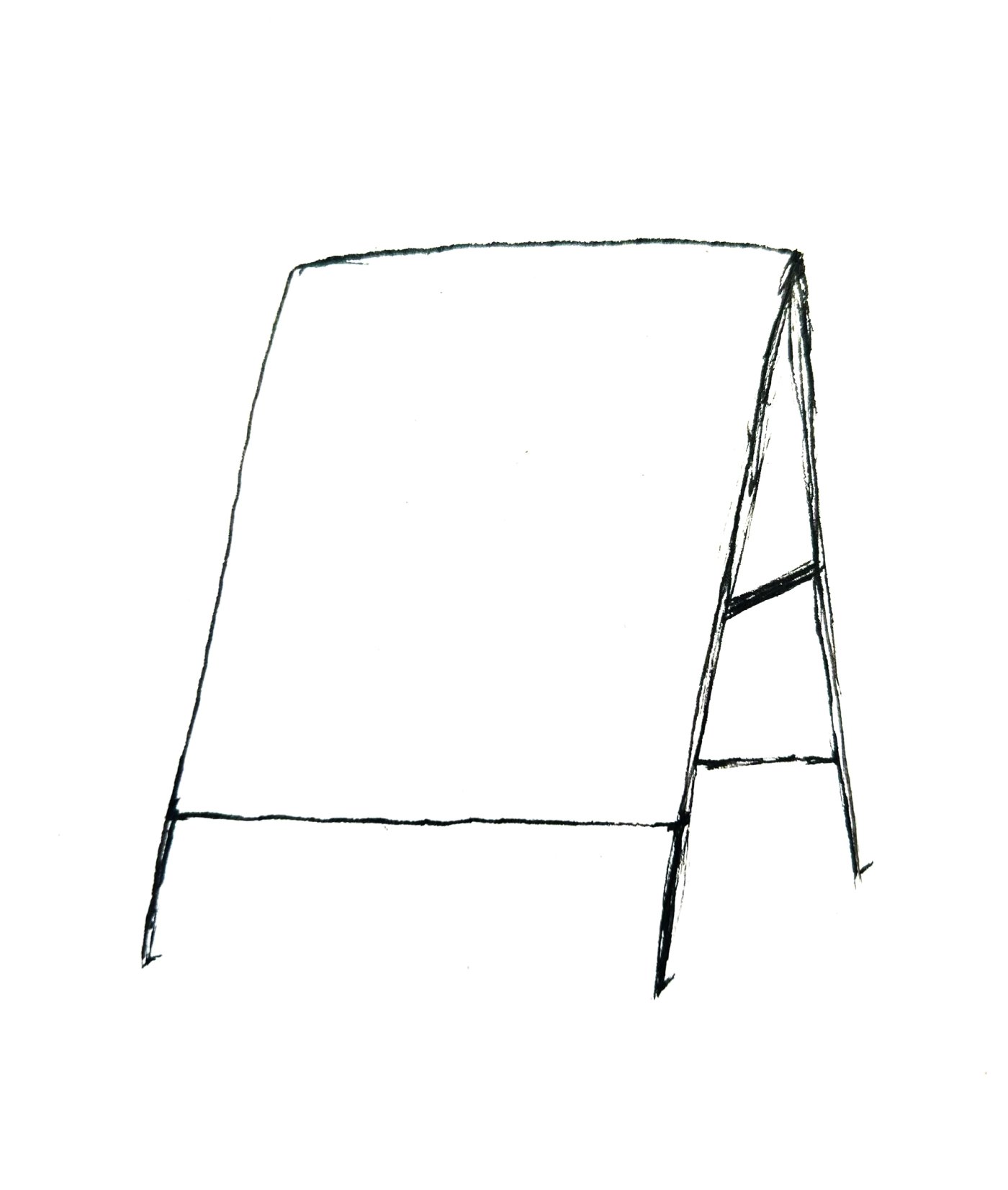
It's the perfect introduction to the sterile, minimalist environment you are about to enter: presumably a coffee shop with an expiration date of two years, equipped with a set of modelesque baristas. And it's all starting to feel like a representation of just how homogeneous and uncreative the coffee scene really is, or is becoming. But what it is on a global scale, is a contribution to urban visual pollution.1Term from Blewitt, John. "Visual pollution: advertising, signage and environmental quality." (2015)
A bit of history
There are not an extensive number of published articles dedicated to A-boards and sandwich boards in particular, but they show up as footnotes or examples within wider academic discussions surrounding street advertising. Regulation around them varies considerably from city to city, with each municipality setting its own rules around licensing, placement, and permitted use.
The sandwich board has a longer history than most people assume. As Irwin2Irwin, Mark. "The Pipes of Christmas Past: Kapp & Peterson and the Sandwichmen of London." Peterson Pipe Notes, 25 Dec. 2018, petersonpipenotes.org/117-the-pipes-of-christmas-past-kapp-peterson-and-the-sandwichmen-of-london/. and Encyclopaedia Britannica3"Sandwich Board." Encyclopaedia Britannica, Britannica Editors, www.britannica.com/topic/sandwich-board. Accessed 6 Apr. 2026. notes its origins stretch back to the 1820s, but it was Charles Dickens who gave it its name and its character, describing the human billboard in Sketches by Boz (1836) as a boy wedged between two boards, an "animated sandwich." The form became a fixture of 19th-century street life, with merchants hiring men and occasionally riders on horseback to carry placards through busy streets. By the early 20th century the practice had largely faded, only to be briefly revived during the Great Depression, when businesses stripped of advertising budgets turned back to this cheap, low-tech solution. The sandwichmen of late Victorian London were recognisable enough as a social type that Reynolds's Newspaper ran an annual Christmas dinner for them from 1895, distributing clothing and essentials afterward, a detail that speaks to just how precarious that particular form of labour was.
Today the A-board has drifted far from those origins. Its traditional role has been to serve local businesses, a tool for wayfinding and catching the eye of passers-by on a tight budget4Wolfe, Charles. "The Sandwich Board Makes a Comeback." Bloomberg, 20 Feb. 2012, www.bloomberg.com/news/articles/2012-02-20/the-sandwich-board-makes-a-comeback.. But the rise of high-end mirrored and stainless steel boards, with precision engraving or professionally printed graphics, signals a different kind of user entirely. These are not small independents scraping together a sidewalk presence. The investment required points to established chains with the margins to spend on premium materials, businesses whose demand is already proven and whose visibility strategy is more about brand reinforcement than survival. The object is the same but the intention behind it has seemingly shifted.
A closer look
The rise of these boards reflects broader design trends, particularly the shift toward minimalism in commercial aesthetics. Heavy materials like stainless steel and mirror-polished surfaces carry a sense of permanence and solidity. Unlike chalkboards, they are not susceptible to rain, and their weight makes them less likely to be displaced by wind. Though one could argue that heat and direct sunlight blasting off a highly reflective surface must create some kind of hindrance, both for the business and for anyone walking past.
The mirror is, in most contexts, an object of private space. We encounter it at home, most often in the bathroom, in moments where we perceive our own physical existence within a space of relative comfort and intimacy. To bring the mirror out into the street is to subvert that entirely, and that subversion is precisely what catches the eye.
But if we focus on the mirror as a mirror, it is impossible to ignore the way these signs also function as an endorsement of social media posting. Most of us have seen it, or done it: crouching down in front of a mirrored sign to take a picture for Instagram. The appeal is layered. It offers the chance to document your presence in an urban space, to signal that you are somewhere stylish or relevant, while the business itself receives free promotion through its branding on the sign. From a purely marketing-driven perspective, it’s a good idea. But beyond that, what could be a call to actual reflection becomes instead a call to performance and visibility.
But there is a case to be made in their favour too. When we talk about commercial visual pollution, it is worth acknowledging that a mirrored surface, by reflecting the street back at itself, technically resists that pollution, it does not impose a brand or a message. In this sense it is among the less aggressive forms of street advertising. But that restraint is itself also somewhat of a strategy. By disguising itself as something usually found in interiors, it camouflages its commerciality within the streetscape, advertising that hides in plain sight, further sustained by the selfies taken in its reflection.
Visual pollution, while widely discussed in architecture and advertising studies, remains a surprisingly ambiguous term. A 2024 collaborative study titled A Systematic Literature Review and Analysis of Visual Pollution5Gao, Hangyu, et al. "A systematic literature review and analysis of visual pollution." Land 13.7 (2024): 994. attempts to address this, acknowledging that the central difficulty has always been subjectivity. The study concludes that visual pollution has become a significant environmental issue driven by rapid and uncontrolled urban expansion, generating both social and aesthetic consequences, and that its effects extend beyond the visual, contributing to anxiety, stress, and a reduced quality of life. And yet the authors are also candid about the limits of the field itself, noting that visual pollution remains largely dependent on public taste and culture, and that limited research has made it difficult to define, analyse, or quantify with any precision. This ambiguity does not make the problem less real. It makes it harder to combat.
Mila Cvetković6Cvetković, Mila, A. Momčilović–Petronijević, and A. Ćurčić. "Visual Pollution of Urban Areas as one of the Main Issues of the 21st Century." 26th International Conference Ecological Truth & Environmental Research. 2018. and her co-authors, writing in 2018, situate visual pollution within a broader ecology of urban harm, noting that while physical pollution of air, water and soil has long dominated environmental discourse, visual and noise pollution are increasingly being brought into the conversation. They draw on James Septh's definition of pollution as simply too much of something in the wrong place, which is perhaps the most honest and useful framing available. They also note that historical monuments are among the most frequent victims of visual pollution7To be fair, Paris does a good job of concealing visual pollution during monument renovations, covering scaffolding with large printed wraps that replicate the facade beneath., which feels particularly pointed when thinking about a city like Paris, a city whose streets carry centuries of architectural and cultural identity and which is now equally legible as a surface for commercial messaging.
What strikes me most in Cvetković's analysis is the concept of identity loss. Visual pollution, she argues, damages the atmosphere of a space and erodes its identity. The consequences she lists are broad: distraction, eye fatigue, a reduction in the comfort and natural diversity of a space, and even a link to excessive consumption, shopping addiction, and the health consequences that follow. The sign, in this reading, is never just a sign.
So what is a city's identity? Is it its monuments? Its streets? Its people? Its commerce? The honest answer is probably all of those things at once, which is exactly what makes the question so difficult to resolve. Street advertising does not exist outside of the city's identity, it is partly constitutive of it. No major city functions without its commercial life, and the street has always been a site of trade as much as of civic or cultural encounter.
But the mirrored A-board feels like a particularly revealing case within this tension. It does not announce itself the way a billboard does. Instead it slips into the streetscape, borrowing the visual language of interior design, reflecting the city back at itself, and in doing so tries to pass as something other than an advertisement. It camouflages its commerciality. And yet it profits quietly and consistently, sustained in no small part by the photographs people take in its reflection, photographs that circulate on social media and extend the reach of the brand without any additional cost to the business.
There is something almost shameless in the elegance of that exchange. The city, already saturated with physical, noise and visual pollution, becomes the backdrop. The street becomes the set. And the person standing in front of the mirror, taking the picture, becomes both the audience and the advertisement. The psychological texture of urban life, the way the city makes us feel, the way it shapes our sense of self and space, has been quietly folded into a marketing strategy. The city's identity, at this point, is inseparable from that process. And it barely even needs to try to hide it anymore.
Overuse and its consequences
And so comes the boredom: a fatigue born from the over-saturation of this type of signage. Where once the A-board carried at least some human touch, the handwritten chalk lettering forms a small act of craft, this quality is now being overshadowed by modern production. While aesthetically these chalk boards remain more pleasing to the eye than their plastic, overtly coloured, cheaply produced counterparts, which catch attention through sheer visual aggression, there is an element of overuse that is stripping these signs of their original value. And in doing so, they begin to weaken the character of their surroundings, imposing themselves onto the street rather than staying within the natural boundaries of the business they serve.
Get RÜTM in your inbox


Album Cover Art, 2025
What legacy, if any, did 2025's best-ranked music album covers leave behind?